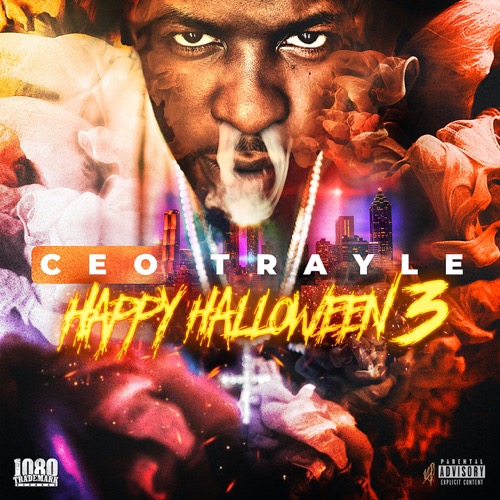

Released on October 30, 2020.
It’s established. Since 2018, almost every year on October 30, CEO Trayle has released an album (or mixtape, or project – we’re not even sure anymore) titled Happy Halloween. If one edition, though, has to be singled out as especially important, it’s the third one, the 2020 release. It arrived at the very moment the Atlanta rapper was breaking through: the year of the official release of “OK Cool,” the track that revealed him to a wider audience. The song through which, as a result and via Gunna, the rapper joined the YSL collective, found his way into the media, and went on to collaborate with Doe Boy and BabyFace Ray.
“OK Cool” is a story about a girl, a brutally honest breakup song, and it’s very good. However, CEO Trayle was right to be irritated at seeing himself defined by it, because it stands somewhat apart from the rest of his catalog. His range, actually, is much broader. Born in New York, having spent time in Alabama, now based in Atlanta and fascinated by Chicago drill, he champions a more eclectic sound that mirrors his own path. He cites influences as varied as 50 Cent, Gucci Mane, Rocko, and Chief Keef. From these references, he has developed a style entirely his own. You can hear it from the very start of Happy Halloween 3. The opening track “Dead President” makes it clear right away, with its looping piano, pitched vocal sample, trap-oriented themes, and heavy basslines reminiscent of UK drill.
If there is one constant to be found in CEO Trayle’s music, it’s the threatening atmosphere sustained by his muffled yet precise voice. Of course, that’s part of the game: the rapper is celebrating Halloween, so he pulls out tracks called “Demons,” “Cutt Off The Head,” or “Hell Date.” But it goes deeper than that. What underlies his rap is the major traumatic episode of his life: on Independence Day, July 4, 2013, when a criminal broke into his home, shot him seven times, and the rapper survived only by killing his attacker.
CEO Trayle refers to that moment at the beginning of “Alter Ego,” a dialogue with his evil double set against an acoustic guitar, which heightens the oppressive atmosphere. It surfaces in his paranoia, in his flirtation with drugs, and in these visions of a nightmarish ghetto that recall the most nihilistic moments of drill. And then, indirectly, in his desire to protect the son he briefly mentions on the excellent “Scandal” – the other reason why CEO Trayle chose to become the rapper we know today, one of the most singular figures in Atlanta.