
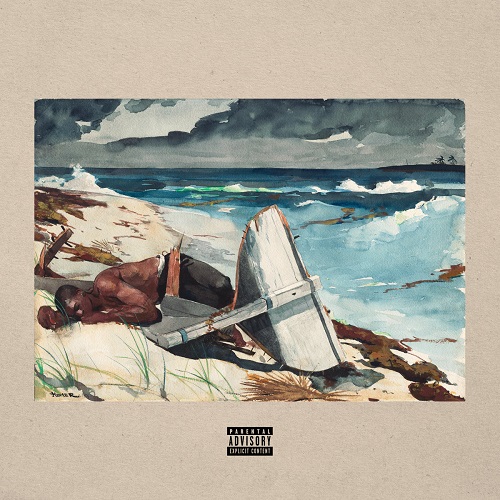

Released on January 24, 2025,
on Fat Possum.
A communist? Really? In rap music? In 2025?
Yes, it seems so. That is indeed what Jaja Gha’is Robinson is. Which, deep down, makes perfect sense in the so deeply polarized Trump-era America. The man showed his colors early on with his blaze, Guevara, and four years ago, with a release titled BlackBolshevik – the work that revealed him. He places himself in the most radical lineage of the Civil Rights movement, the one willing to rub shoulders with the socialist enemy.
The Philadelphia-born rapper is a leftist, and the son of leftists. And in times that are far from kind to this family of thought in America, he has settled in Uncle Sam’s reds’ usual refuge: Europe. It is from London, in fact, that he delivers his new message. And he does so under another alias, Goyard Ibn Said, inspired by the Muslim sage Omar ibn Said, one of the very few Black American slaves who had the time and means to write an autobiography.
This release enjoys all the more visibility as the man has just joined a label, Fat Possum, and as his single “The Old Guard Is Dead” rang out during SZA’s and Kendrick Lamar’s performances at the last Super Bowl. And on this concept album – at the very moment his name is leaving obscurity – Ghais Guevara comments on the torments of success and the perversions of rap-as-spectacle society: that of the new minstrel shows, of those rappers who play the dangerous gangster game, which the track “Leprosy” calls out directly.
The album is split in two major moments. A first act is announced by the thunderous aforementioned single, “The Old Guard Is Dead,” where the proud and effective sample of a Russian opera by Anton Rubinstein resounds, and where the rapper delivers a text entirely devoted to success. This opening section, triumphant and elevated, celebrates achievement. Here, the rapper appropriates the themes of braggadocious rap. Irony and mockery are present nonetheless. If you listen closely, he criticizes his most materialistic peers, declaring on “I Gazed Upon The Trap With Ambition” that what would truly leave a mark would be a horror film titled “n****s with a brain,” rather than the contemporary rap circus. But at this stage, these jabs remain implicit.
In the second part, Ghais Guevara becomes more overtly grave and serious. He embarks on introspective and pessimistic tirades, revealing the other side of the coin, as on the harpsichord-led “The Apple That Scarcely Fell.” He addresses intimate and societal subjects. Vulnerability, sex addiction, adultery, identity, patriarchy, are some of the themes explored. This rapper is earnest, and here we find like-minded peers: McKinley Dixon, who appears on the latter track, and Elucid, featured on “Bystander Effect.”
Ghais Guevara also surrounds himself with demanding music. His sounds are in tune with the lyrics. The main foundation is adult rapper music: boom-bap samples and loops. He rejects easy formulas, with a good dose of experimentation, some stripped-down and minimalist moments, and at times the electronic music of the country where Guevara has settled, such as the drum’n’bass on the excellent “4L.”
Trap music and its offshoots are present as well. They are very apparent in the rhythms, in certain flows, and in the use of onomatopoeia. This broadens the range. For better or for worse, it brings something new, as with the orchestral trap of “Branded.” It injects freshness and energy into this rap of young old depressives.
The music is never simple or one-dimensional. Likewise, you never quite know whether this rapper is being ironic or sincere. It’s not only others he denounces – it may also be himself, as on the excellent “3400,” whose title counts the miles separating his London refuge from his Philadelphia neighborhood, and which confesses that you never really detach yourself from the ghetto.
Ghais Guevara deals with a world that is nothing but a theater, in which we are all actors, on another standout moment, the aforementioned “I Gazed Upon The Trap With Ambition.” And because he knows that he himself contributes to the great rap show (“You Can Skip This Part”) – despite everything he does not entirely give up participating in it – this album is, overall, a success.