
Released February 6, 2003,
on Shady Records, Aftermath Entertainment, and Interscope Records.
Here it is: the colossal blockbuster of 2003, the album whose phenomenal success set the tone for the mid-2000s. A true turning point. A genuine game changer. At that exact moment, it confirmed, established, and rewrote several of hip-hop’s fundamental rules.
Artists who built their reputation by flooding the streets with mixtapes? That was 50 Cent, whose unofficial releases (Guess Who’s Back?, 50 Cent Is the Future, No Mercy, No Fear) echoed throughout New York City, generating unprecedented buzz before he went on to conquer the world.
Rappers who proved their gangster credentials through real-life violence at the expense of their own bodies? Again, it was him. The nine bullets that tore through him in 2000 left behind not only scars but also the slight slur that became his trademark vocal characteristic.
Superstars whose status depended more on the aura of their persona than on dazzling lyrical prowess? Once again, Curtis Jackson.
And while many rappers had done it before him, 50 Cent reminded everyone just how effective it could be to move as a pack, relying on Lloyd Banks, Tony Yayo, and the G-Unit collective.
Another strength of Get Rich Or Die Tryin’ is its ability to draw from every corner of hip-hop. 50 Cent was unmistakably New York, but as Eminem’s and Dr. Dre’s endorsement made clear, his music transcended geography. His style incorporated elements from well beyond his Queens neighborhood. “P.I.M.P.” reflected a fascination with the pimp archetype that had long been deeply rooted on both the West Coast and in the South. Meanwhile, the album’s flagship single, “In Da Club” – yet another legendary Dr. Dre production – shared Southern rap’s growing obsession with the nightclub. Eminem drives this point home on “Patiently Waiting,” where he claims that 50 Cent is a synthesis of 2Pac and Biggie, with a touch of Big L, the iconic fallen legends of rival coasts. In other words, he transcended regional divisions.
50 Cent also helped popularize the South’s emerging formulas through his exaggerated brand of gangsta rap and the bouncing, swirling production heard on “Blood Hound.” While hardly one of the album’s strongest cuts, it served to introduce G-Unit’s newest recruit, Nashville rapper Young Buck.
I’m from New York, but I sound Southern
… 50 boasts on the boastful “Like My Style.” And he’s absolutely right, not just because of his voice and delivery.
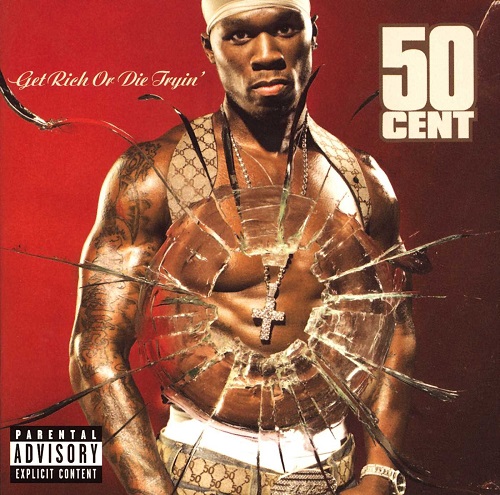
Of course, as foreshadowed by the He-Man-like album cover and the opening sounds of the record – a coin dropping, followed by the click of a gun’s trigger – the man who promised to get rich or die trying carefully cultivated the image of a ruthless criminal. Much of the album, from “What Up Gangsta” to “If I Can’t,” paints him as the ultimate larger-than-life gangster, surrounded by violence and backed by thunderous production.
On the crushing “Patiently Waiting,” the shooting he survived allows Eminem to portray him as an invincible hero returned from the dead. That same event becomes the foundation of his street credibility on the melodic yet deceptively gentle “Many Men,” one of the album’s undeniable highlights. To make the point even clearer, bursts of gunfire provide the rhythm on the menacing “Heat,” a song built around death threats.
A similar formula powers “Don’t Push Me.” Alongside Eminem and Lloyd Banks, 50 Cent brandishes both his gun and his threats. Combative as ever, he also continues the string of beefs he launched with “How To Rob,” the 1999 single that first put him on the map by imagining himself robbing dozens of rappers and singers. He keeps his feud with Ja Rule alive – a rivalry that had already led to him being stabbed just weeks before he was shot. That old enemy isn’t forgotten, receiving a barrage of insults on “Back Down.” Nor is he spared on “Wanksta,” 50’s first single following his alliance with Eminem, later added as a bonus track on subsequent editions of the album alongside several other standout cuts from his mixtape era.
This album represents the ultimate triumph of gangsta rap in its most mechanical and nihilistic form, stripped of nearly all the social reportage that had once lent street rap a measure of legitimacy. One almost forgets that, before this, credible alternatives to that style still existed.
Yet beyond the towering performance of an invincible, muscle-bound outlaw, the album offers something for everyone. There’s the club anthem, of course, with the monumental “In Da Club.” There’s the relationship song, “21 Questions,” where, alongside Nate Dogg, 50 wonders whether his partner’s feelings are genuine. And there’s the weed smoker’s anthem, “High All The Time”, a somewhat calculated move considering that 50 Cent has never hidden his relatively clean lifestyle, steering clear of alcohol and drugs.
After Get Rich Or Die Tryin’, this same balance of street records, club hits, love songs, and lifestyle tracks would become the blueprint for virtually every rap blockbuster. Following such an overwhelming success, the deck was reshuffled, the rules rewritten, and the path to commercial triumph clearly laid out. Every rapper would go on chasing the American dream embodied by the album’s title, Get Rich Or Die Tryin’, and songs like “Poor Lil Rich”: from the ghetto to crime, and from rap to superstardom.