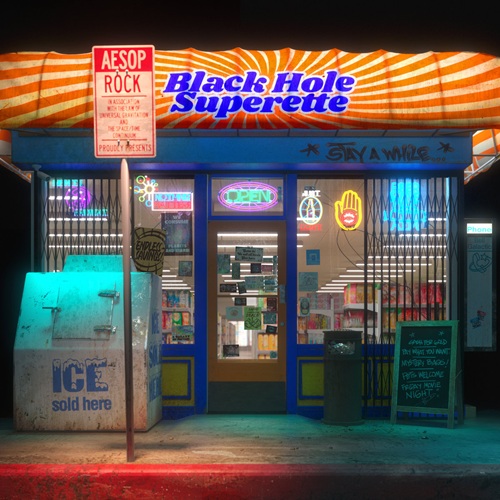

Released on May 30, 2025,
on Rhymesayers Entertainment.
The old indie rap movement largely emphasized lyrical inventiveness and musical creativity, sometimes even advocating experimentation. It often promoted strange sounds seemingly coming from another universe. Its raps frequently transported us into hallucinatory science fiction worlds, reminiscent of Philip K. Dick. And yet, paradoxically, its lyrics most often focused on everyday life and intimate struggles. While mainstream rap shared its dreams of grandeur, staging a flashy world of unreal luxury, Slug told us his stories and troubles with women, and El-P settled scores with his stepfather.
Throughout his very rich career, Aesop Rock has also embodied this contradiction, and he does so again on his latest album. The beats, which he has been producing himself for quite some time, are abrasive. This is noise art, in the noble but old tradition of the Bomb Squad. The lyrics are intricate and convoluted, as expected from a rapper renowned for his insane vocabulary. They tell strange stories, like the snail invasion on “Snail Zero.” They are particularly hard to follow and decipher. And it’s barely any easier with his collaborators, other wordsmiths such as the duo Armand Hammer, Homeboy Sandman, or Open Mike Eagle. Yet the texts, contrary to the ego-trips inherent to rap, deal with decidedly mundane subjects.
The title says it all: on the surface, it looks like science fiction (“Black Hole”), but in reality, Aes takes us through his ordinary life (“Superette”). The excellent opening track, “Secret Knock,” makes no different claim: with its psychedelic music, El-P–style percussion, cryptic statements, and complex wording (but what does “Hydrangea Gatorade” even mean?), it seems to plunge us into a strange world. And yet, in the end, that world is our everyday reality.
Some famous rock musicians once felt lost in the supermarket. Aes, on the other hand, is trapped there (“Checkers”). He describes himself as a simple man in sneakers and a white T-shirt (“Himalayan Yak Chew”). He talks about his dog amid esoteric reflections (“Movie Night”). He observes flocks of swifts perched on Portland’s chimneys (“Bird School”). He explores his memories, such as that of his childhood hamster (the final and superb “Unbelievable Shenanigans”). He recalls a “John something” who introduced him to the documentary When We Were Kings in 1996 (“John Something”). In another dense internal monologue, he talks about gardening and trying out cooking recipes (“EWR – Terminal A, Gate 20”), and later, dirty dishes (“Costco”)… The only moment where the rapper boasts is “Ice Sold Here,” but it mostly feels like a parody.
Aesop Rock is not a superhero who masters the world, but someone who endures it, as he admits amid the complex existential reflections of “So Be It.” And on “Black Plums,” in the midst of a midlife crisis, he urges us to accept our insignificance. It’s all very low-key. But that doesn’t stop the rapper from delivering another solid album. Over sixty-eight long minutes and eighteen tracks with little variation, we endure the crushed sounds and Aesop Rock’s monotone voice, and it is genuinely exhausting. And yet, this very unusual way of talking about normality can be deeply satisfying. With him, it has been for nearly thirty years.