
Released on February 22, 2000,
on 75 Ark.
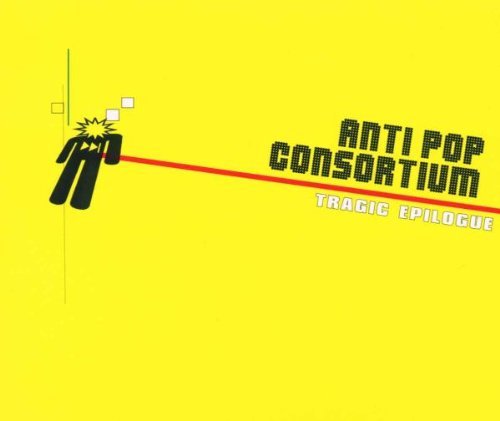
The very name Antipop Consortium, like the arty cover of their debut album, leaves little doubt as to the trio’s intentions. Emerging from the Nuyorican Café and the Rap Meets Poetry movement, a breeding ground for New York’s spoken word scene, High Priest, Beans and M. Sayyid, backed by DJ E. Blaize, offer with Tragic Epilogue the exact opposite of the commercial rap that had become the dominant form of popular music by the end of the 1990s. Hardly surprising for a group that collaborates with DJ Vadim, cites Sun Ra and Ornette Coleman as influences, counts Company Flow and Mike Ladd among its peers, and associates with artists as diverse as Arto Lindsay, Alec Empire and Vernon Reid.
There is no point looking for a hit on an Antipop Consortium record: Tragic Epilogue is an album that demands something from the listener. That is true of the music, a kind of slow-moving electro built from sparse, synthetic sounds, resistant to conspicuous samples and constructed around intricately crafted rhythms. It is equally true of the opaque lyrics, masterfully delivered by three unforgettable voices. As an added bonus, the trio enlists two cult and virtuoso rappers on the album, two icons of underground hip-hop: Organized Konfusion’s Pharoahe Monch on the haunting “What I Am,” and Freestyle Fellowship’s Aceyalone over the Indian-inflected sounds of the long and unsettling “Heat Rays.”
All of this possesses a dark grace rarely heard since Funcrusher Plus, and a strangeness of the kind only that madman Kool Keith seems to relish. With the driving “Laundry,” the cutting electro of “Nude Paper,” the sinister calm of “Your World Is Flat,” the futurism of “Here They Come Now,” the insistent, experimental “Moon Zero X-M,” the abrasive “Lift,” the free jazz of “Eyewall,” the long and languid “Sllab,” the booming bass of “Smores,” a “Disorientation” partly performed by rapper Apani B, and the bizarre “What I Am,” Antipop Consortium delivers one of the most striking sequences of tracks ever heard on a rap album.
The experimental trappings of Tragic Epilogue and the strange poetry of its three main protagonists push rap in new directions. Yet at the same time, paradoxically, they take it back to the era of Downtown Manhattan, when, in the early 1980s, the first rappers mingled with New York’s artistic intelligentsia, when rap and electronic music had not yet gone their separate ways, and together they gave birth to sounds both strange and delicious.