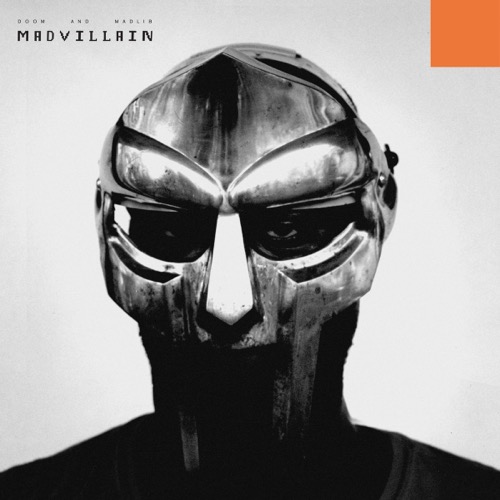

Released on March 23, 2004,
on Stones Throw Records.
At the dawn of the 2000s, everything became clear. Independent hip-hop — the movement that had swept across America and beyond a few years earlier, thrusting countless unknowns to the forefront of every North American location, each one certain they were saving their music — was, above all, a crisis of growing up. This wasn’t about hip-hop’s future. It was that inevitable moment when the thrill of novelty surrenders to a fascination with form.
Madvillainy embodies that shift. By 2004, the excitement had cooled; the indie — or underground — wave was already history. Yet a handful of aesthetes survived that era, largely unknown to the wider public but championed by critics. MF DOOM and Madlib stood at the forefront. The former: a veteran, ill-fated New York rapper (later relocated to Atlanta) reinvented as a comic-book supervillain, and an occasional producer. The latter: a California producer born into a family of musicians, steeped in jazz, and an occasional rapper.
The two could hardly be more different, yet both had become touchstones — one through the singles collected on 1999’s Operation: Doomsday and the projects that followed, the other through Lootpack and his Quasimoto alias. Each was bound to a legendary indie label: the New Yorker to Bobbito Garcia’s Fondle’Em, the Californian to Peanut Butter Wolf’s Stones Throw. Both delighted in blurring their own identities, endlessly swapping aliases and directions. By 2004, they had already been working together for two years, and the pairing of these underground icons stoked enormous expectations — especially since a stolen advance of Madvillainy had already leaked online, and the leak was outstanding, with some calling it superior to the finished album.
Despite respectable success for an indie release – bringing Stones Throw much-needed revenue – and a reputation that kept growing, Madvillainy never chased mass appeal. Packed with brief songs, almost entirely without choruses, and marked by a more subdued MF DOOM than usual, it is an art object. The culmination of disciplines already belonging to another era – the craft of flow, the perfect sample, scholarly crate-digging – it is, at bottom, the work of aesthetes.
MF DOOM and Madlib play. They play with old alter egos (Quasimoto surfaces twice; MF DOOM becomes Viktor Vaughn again on “Fancy Clown”). They play with the pop culture they love, wandering through it via an intricate collage of samples and references. They play with absurd interludes and elegant instrumentals, with rap voices assembled to celebrate weed on “America’s Most Blunted,” with off-kilter singing instead of rapping on the jazzy, playful “Rainbows.”
The pair also indulge in the well-worn ego-trip, but through words and sounds unlike anything usually tied to the form, as on “Accordion.” They deliver esoteric lyrics inspired by Sun Ra on “Shadows Of Tomorrow,” the only track performed entirely by Quasimoto (and by Madlib in his own voice). They stage deadpan sketches like “Operation Lifesaver AKA Mint Test,” about a girl with terrible breath – and, by contrast, a serious meditation on police brutality and warmongers’ cynicism on “Strange Ways.”
It’s a spectacle more than a wonder. It’s rap that aged alongside its audience, growing more intellectual as it went. Guest rapper Wildchild says it himself on “Hardcore Hustle”: this is art. This is jazz. Like Frank Zappa – sampled on “Meat Grinder” – it’s too clever, too detached, too steeped in reference to be more than “interesting.” Which is why this site, the historic home of MF DOOM’s biggest fans in France, had never reviewed the album yet. Why it was never truly won over by Madvillainy.