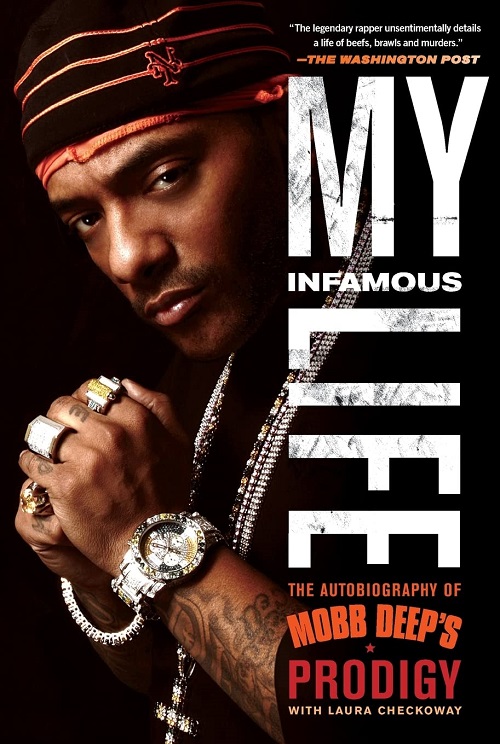

Published on April 19, 2011,
by Touchstone Books.
Rappers’ autobiographies are rarely all that interesting. By their very nature, they are self-centered. The author talks about himself and rarely places his story within a broader reflection on his art. Most of the time, he does exactly what he does in his songs: he boasts, shows off, and builds himself a persona. Unless your name is J-Zone and you happen to have a strong taste for self-deprecation, you spend your time justifying yourself, trying at all costs to prove how authentic you are – at the risk of not being quite as authentic as you claim.
Co-written with Laura Checkoway, My Infamous Life is an emblematic rap biography, and it is no exception. Albert Johnson (his real name) tells his own story. He shows us that he really is the hard, ruthless rapper portrayed in his lyrics. And sometimes he bends reality, as when he claims that Biggie took inspiration from Mobb Deep’s classic The Infamous when choosing the name “The Notorious” (as far as I know, he was already calling himself the Notorious B.I.G. on Ready To Die, a year before The Infamous).
People have sometimes rather spitefully pointed out that the members of Mobb Deep – the quintessential duo of dark New York street rap – met at an arts school, and that their families were not exactly destitute. That is true, and Prodigy makes no attempt to deny it. Right from the outset, he traces the genealogy of a family full of colorful personalities – a jazz-musician grandfather, a mother who belonged to the 1960s group the Crystals – and one in which money, particularly his grandmother’s (the famous “head nigga in charge” after whom he would later name his solo album), was never really a problem. But he is equally determined to remind us that he genuinely lived in the urban jungle he and Havoc depict in their raps. As he puts it, people need to understand that what Mobb Deep talks about is real. He does not want to be like Jay-Z, whom he accuses of being a fraud.
Despite their means and connections, his family never left the ghetto. He grew up in a world of gangs where the rule is to prove yourself the toughest, where someone claiming to be your friend might steal the gold chain from around your neck, and where you always need to keep your gun within reach. His father, whom he idolizes, was a hustler constantly on the run from the police. Prodigy himself experienced drug dealing, violence, prison, and car chases with the cops. Members of his crew were killed, and he himself was hardly reluctant to use his weapon. For a few days, he was even a pimp.
Prodigy really was a man of the streets. He was neither bourgeois nor an intellectual. He was self-taught, building his worldview by reading conspiracy-minded authors; a man who adamantly maintains that he once saw a UFO, and who reminds us that Americans are notoriously bad at geography when he claims to have gazed upon the Moroccan coastline from the port of Marseille… My Infamous Life, then, is faithful to Mobb Deep. If Prodigy is to be believed, there is very little distance between fiction and reality. The book therefore resembles his songs: it is a succession of scenes set in the harsh world of New York’s streets. And, of course, it is also an account of the life of a star.
One day, while reading a review of my own books, I saw someone complain that they did not contain enough anecdotes. Anecdotes, really? Is that what people want? If so, My Infamous Life gives them plenty.
Prodigy serves up several rap variations on the mythology of sex, drugs & rock ’n’ roll. Guys wrecked by drugs, long nights of debauchery after the madness of concerts, trips around the world, groupies, infidelities – all these stories, sometimes colorful and ultimately rather sordid, make up a substantial part of the narrative. And to spice things up, many of the people involved are rap stars. Prodigy moves through a small world in which Nas, Jay-Z, and the rest are constantly circulating and crossing paths, a world continually punctuated by altercations of every kind – a world so volatile that we learn the police even set up a “hip-hop task force” to keep tabs on it.
And then, right in the middle of all this chaos, there is 50 Cent. A man of contrasts: he does not drink, does not take drugs, looks after his body, stays at the hotel after nights out, plays babysitter to the others, understands the value of public relations, and absolutely does not mess around when it comes to business. In short, amid this crowd of dilettantes, he is the serious guy – and as such, the one who achieves lasting success.
So yes, there are plenty of anecdotes. But anecdotes, by their very nature, are anecdotal. Prodigy lived in the ghetto; he lived the life of a rock star. Well, imagine that… Where is the scoop? What does this book actually add? Its real value, actually, lies in what it tells us about the making of a talented man, when it explains how Albert Johnson became the aptly named Prodigy – the prodigy.
First, as already mentioned, he tells us that he was born into show business. Between his grandfather’s jazz clubs and his grandmother’s dance school, he was exposed to the life of an artist from a very early age. There was something almost hereditary about it. And also, there was the sickle cell disease.
Prodigy suffered from the disease his entire life. He suffered horribly, to a degree that healthy people cannot imagine. Because of it, there was so much he simply could not do. Physical exertion would trigger new attacks and send him to the hospital. He had talked about this in his raps before, too – most notably in “You Can Never Feel My Pain” – but never at such length or in such detail as in My Infamous Life.
And as you make your way through the book, one thing becomes increasingly clear: if this vicious genetic disease ultimately killed Albert Johnson in 2017, perhaps it was also the very thing that gave birth to Prodigy.