
Released May 1, 2026,
on Heavenly Recordings.
They would certainly dispute the “British” part of that description, but Mo Chara, Móglaí Bap and DJ Próvaí are, today, among the true mavericks of British music. These rappers, who blend street culture with Irish nationalist activism in Ulster – and named themselves after a brutal punishment once meted out by the IRA – have caused outrage well beyond the UK. Their outspoken support for Gaza even led to accusations that they were endorsing terrorism. Here in France, their booking at Rock en Seine cost the festival some of its public funding, while Kneecap found themselves reduced – wrongly, they insist – to “those Irish rappers who support Hezbollah.”
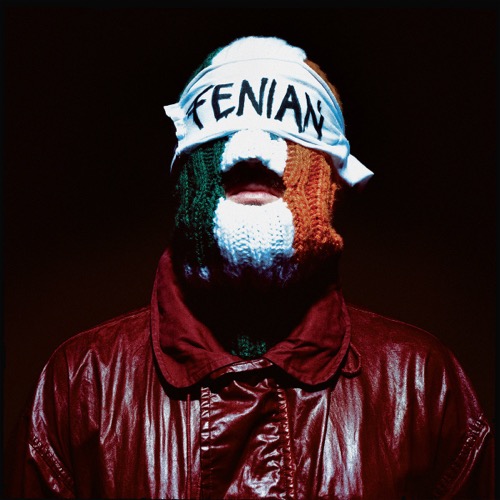
Perhaps all this would be less of an issue if Kneecap were not actually a very good band. Their latest album, Fenian, recorded in the wake of all that media uproar, is proof enough.
Activism is their stock-in-trade, so of course it is still there. More than ever. Their emblem, a tricolour balaclava in the colours of the Irish flag, adorns the cover. The album takes its name from Ireland’s legendary warriors. National identity is the subject of the excellent “Smugglers & Scholars.” The lyrics are as often in Irish as they are in English, and the language itself is fiercely defended on “Gael Phonics.” British occupation is denounced on “Occupied 6.” The British come in for a battering on “An Ra.”
And Kneecap have not backed away from their pro-Palestinian stance. They reaffirm it on a track named after Palestine itself, with help from Fawzi, a rapper from Ramallah. Elsewhere, on “Carnival,” Mo Chara revisits his trial for allegedly supporting terrorism, which he regards as a farce. And on “Liar’s Tale,” still on the same subject – the parallel drawn between the occupations of Gaza and Ulster, and Britain’s role in both – he takes aim at Keir Starmer and at an Irish establishment he sees as complicit.
In truth, Fenian feeds off the controversy. It capitalises on Kneecap’s newfound international profile. It does so through the provocation of its lyrics, certainly, but through the music too. That is every bit as blunt and uncompromising, and just as determined to push far beyond the confines of rap. After all, isn’t the trio signed to Heavenly Recordings, the label of Saint Etienne and Beth Orton? Aren’t they working here with Dan Carey, producer of Fontaines D.C., among many others? Don’t they appropriate a John Martyn song on “Cocaine Hill”? Don’t they nod to the Undertones on “Occupied 6”?
In reality, several decades of British music are compressed into Kneecap’s rap. Rock, punk, reggae, techno, trip-hop, drum’n’bass, grime and more are thrown together with old-school American hip-hop influences. With Kneecap, the political fury of Public Enemy, the gangsta aggression of N.W.A and the irreverence of the Beastie Boys collide with the punk-techno assault of Prodigy.
Apart from the more intimate tracks, which may well be the album’s best – “Cocaine Hill,” about addiction, and “Irish Goodbye,” about the suicide of Móglaí Bap’s mother – subtlety is not always the point. But the formula is tried and tested, it works, and ultimately it should outlast the controversies. Kneecap’s colors, imagery and slogans verge on folklore. Their language will not be understood by everyone. In the end, what will they actually contribute to the causes they claim to defend? Probably not much. To music, though – British or Irish, take your pick – they certainly will.