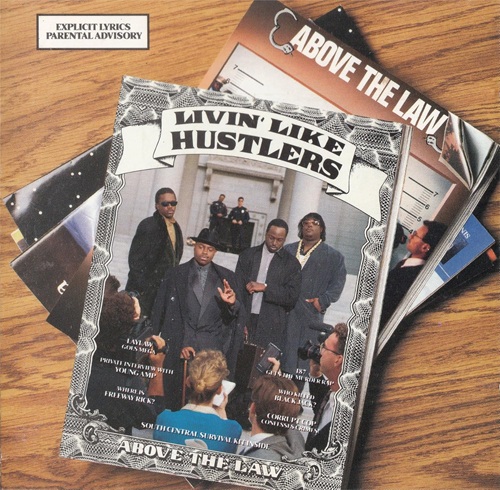

Released February 20, 1990,
on Ruthless Records.
At the turn of the 1980s and 1990s, gangsta rap was coming into its own. But for it to become a full-fledged movement, it needed more than N.W.A. and their landmark manifesto, Straight Outta Compton. It needed another major group. Above The Law would never achieve the same level of success, but they would fill that role. Also released on Ruthless Records thanks to their mentor Laylaw, the Pomona group’s albums have become part of the California rap canon, particularly their debut, Livin’ Like Hustlers.
A year after the explosion of N.W.A., Above The Law took the gangsta persona to its logical extreme. Its members perfected the formula, right down to their stage names (the 187 in Cold 187um refers to the section of the California Penal Code dealing with murder). Their raps were aggressive (“Menace To Society”). Murder was addressed in the bluntest possible terms (the single “Murder Rap”, “Another Execution”). The two MCs made no bones about presenting themselves as unrepentant outlaws (the swaggering single “Untouchable”).
Livin’ Like Hustlers matters because it lent further weight to the gangsta rap formula. But that is not all. In retrospect, it is also frequently recognized as the starting point of g-funk.
In some respects, this was still very much 1980s rap, carrying on the tradition of James Brown’s heavy, frenetic funk. On “Murder Rap”, the music is packed with the same noisy, cacophonous beats already heard on N.W.A. records, themselves little more than an extension of the Bomb Squad sound. The incendiary “Freedom Of Speech”, with its politically charged lyrics, also brings Public Enemy to mind. The minimalist “Just Kickin’ Lyrics” sounds every inch the old-school ego trip. Meanwhile, the two rappers play off each other with the playful chemistry characteristic of the decade drawing to a close, suddenly rapping in unison or finishing each other’s lines: KM.G with his deep, rumbling voice, and Cold 187um with his lighter tone and more agitated delivery. Yet the future is already quietly beginning to creep in.
Alongside their violent outbursts, Above The Law can also be heard coolly and brazenly celebrating the pleasures of the gangster lifestyle (“Livin’ Like Hustlers”, “Ballin'”) and the sensual indulgences of a pimp’s existence (“Flow On (Move Me No Mountain)”). Criminality is no longer merely a consequence of society’s ills: it becomes a way of life. And the music, to match this shift in attitude, grows less frantic. It becomes more melodic. It draws on mellow soul and syrupy funk rather than their fiercer sides. It even becomes more sophisticated, gaining depth and richness. This is particularly apparent on the excellent closing posse cut, “The Last Song”, where N.W.A. join the party.
According to Cold 187um, it was his idea to bring smoother, more seductive sounds into his otherwise hard-edged rap. After all, isn’t Gregory Hutchinson the nephew of Motown singer Willie Hutch? And wasn’t he trained in jazz? He even claims to have coined the term “g-funk”. Dr. Dre, who helped put the finishing touches on the production of Livin’ Like Hustlers, certainly took the lesson to heart. Two years later, he would put it to spectacular use on an album whose title came from a slang term that had already appeared on this very Above The Law record: The Chronic.