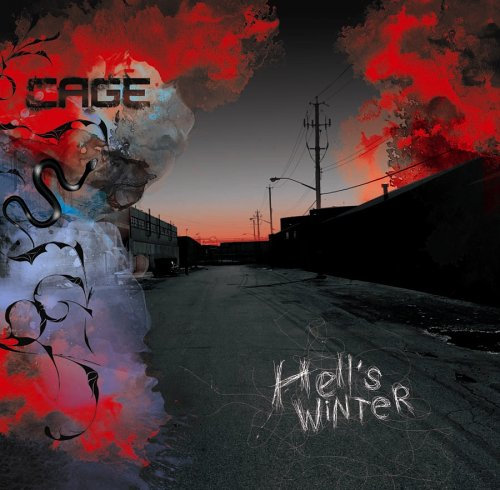

Released September 20, 2005,
on Definitive Jux.
For a long time, Cage was one of rap’s great missed opportunities. In the mid-’90s, after catching Pete Nice’s attention, he signed with Columbia, only for the major label to lose interest in a hopeless junkie who couldn’t even show up sober to recording sessions. Later, like so many talented rappers abandoned by the record industry, he found a home with Bobbito Garcia’s Fondle ’Em label, where he released his legendary single “Radiohead / Agent Orange.” Shortly afterward came his infamous feud with Eminem. But in this showdown between two unhinged white rappers from dysfunctional families, it was Eminem who proved far better at managing his career.
Cage, meanwhile, was left to soldier on in the underground. He joined several groups: Smut Peddlers (with The High & Mighty), Nighthawks (with Camu Tao), and the Weathermen (with Camu Tao, El-P, Copywrite, Yak Ballz, Tame One, Breeze Brewin, Jakki tha Motamouth, and Vast Aire). He also released Movies For The Blind, a debut album that, while hardly bad, largely flew under the radar.
What this troubled character lacked was vision, consistency, and the right people in his corner. El-P gave him all three when he brought him onto his Def Jux label. For Cage’s second solo album, Hell’s Winter, he assembled some of the underground’s finest producers: alongside El-P himself and Camu Tao, Blockhead, RJD2, and even DJ Shadow were brought on board. A handful of rock musicians joined the proceedings, too: Daryl Palumbo on vocals, Yo La Tengo’s James McNew on bass, and Chavez’s Matt Sweeney on guitar. Even good old Jello Biafra of the Dead Kennedys made an appearance, channeling his trademark brand of caustic, politically charged punk rock by playing George W. Bush on “Grand Ol Party Crash.”
Of course, the Def Jux formula has its downside. Sometimes El-P simply goes overboard. His brand of progressive hip-hop, shot through with rock aggression, piles on the noise, experimentation, and unexpected twists until the beats become downright punishing to the ears. Here, though, those excesses are tempered by other producers, who steer Cage into more melancholy territory, as on the excellent Blockhead co-produced “Stripes” or RJD2’s “Shoot Frank.” And if anyone is equipped to make this kind of white-boy hip-hop work, if there’s one rapper whose voice belongs over these abrasive, fractured soundscapes, it’s a broken man like Cage. Especially when, as he does here, he’s firing on all cylinders.
At times, he still slips into his nihilistic, provocative, misogynistic persona, as on the sleazy “Perfect World” or “Lord Have Mercy,” a densely woven tale featuring, among other horrors, a pedophile priest and medical students fooling around with corpses. Cage takes perverse delight in portraying himself as a strung-out wreck over the old-school beat of “Peeranoia,” and in spinning gruesome yarns on “Subtle Art Of The Break Up Song,” where he describes murdering his girlfriend in a car on her birthday. But he also reveals what created this monster in the first place.
On “Good Morning,” he revisits the world he grew up in: a savage New York where homeless people sleep in cardboard boxes in the shadow of Donald Trump’s millions. On “The Death Of Chris Palko,” he explains how Christian Palko, the man behind the name, became Cage, the deeply damaged rapper. He lays bare a childhood marked by squalor and trauma. “Too Heavy For Cherubs” and “Stripes” revisit a father who, when Cage was just six years old, beat him, made him help inject heroin, and assaulted his pregnant wife. “Shoot Frank” explores the rapper’s escape into drugs, both the cause of his troubles and his way of coping with them. In Cage’s world, misery breeds misery, and damaged people gravitate toward one another, as on “Scenester,” where he describes a girlfriend every bit as troubled as himself.
Giving equal voice to Cage the repellent provocateur and Cage the wounded human being, while also delivering all the familiar hip-hop staples – a posse cut (“Left It To Us”), a boastful ego trip (“Public Property,” complete with a jab at his former label, Eastern Conference) – Hell’s Winter culminates in a sprawling, monumental title track. El-P is at the top of his game, while Cage declares that music and his fans are the only things that can save him. The result is a remarkably accomplished album, the most balanced work by a rapper who, in his own life, has rarely known anything resembling balance.