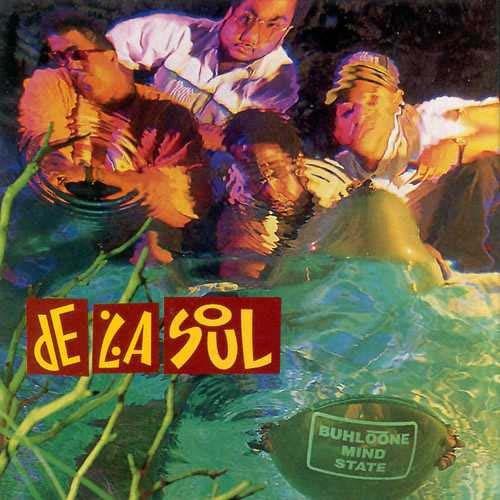

Released on September 21, 1993,
on Tommy Boy Records.
Funny, creative and relevant as they would remain later on, nothing in De La Soul’s discography surpasses their opening run of three albums. Even today, with the group reduced to a duo, they have retained plenty of what made them special, but nothing has topped those three Prince Paul-produced releases. On the last of them, Buhloone Mindstate, you can already hear some of the resentment and seriousness that would weigh down its successor, Stakes Is High, while the album also bears the imprint of the prevailing trends of the time. Yet the producer’s sample-crazed madness continues to elevate the trio’s imagination.
In this corner of New York hip-hop, 1993 marked the high-water mark of the jazz-rap wave, and the Long Island trio were hardly immune to it. The album’s longest track, “Patti Dooke,” is the clearest example: it brings together three jazz veterans – Maceo Parker, Fred Wesley and Pee Wee Ellis – along with Guru, the great master of ceremonies of the marriage between jazz and hip-hop. Parker is even given a very fine instrumental showcase of his own, “I Be Blowin’.” But this is De La Soul, after all, and this is Prince Paul: the influences and experiments range much further afield.
It is entirely in keeping with the trio’s spirit – by then almost a quartet, thanks to rapper Shortie No Mass – to invite Japanese artists Scha Dara Parr and Takagi Kan onto “Long Island Wildin’.” It comes naturally to them to make an album that feels like a treasure chest, where every extra word and every additional note seems to contain another new idea. It is typical of them to be as funny as they are on “3 Days Later,” about a sexual encounter that ends in an STD. It is no surprise to hear them toy with absurd repetition on the interlude “Dave Has A Problem… Seriously.” Nor is there anything unusual, by their standards, about ending a track like “Eye Patch” with children laughing and goats bleating, or opening another, “Ego Trippin’ (Part Two),” with screams – and somehow making it all feel perfectly natural.
It is also quintessentially De La Soul never to be too direct, but always clever: to tackle big subjects almost in passing, tucked away inside their playful lyrics. The clearest examples are, once again, “Patti Dooke,” where the trio proclaim their attachment to their Black roots and their refusal to compromise themselves, and, over the same backing track as “I Be Blowin’,” the meditation on identity that is “I Am I Be.”
When Buhloone Mindstate was released, it was not fully appreciated for what it was. This time, commercial success did not quite follow. In that frantic era, when rap was evolving at breakneck speed, De La Soul’s formula already seemed anachronistic. Indeed, a certain nostalgia emerges for the bygone period that had shaped them. The deliberately old-school beatboxing tribute “Stone Age,” featuring Biz Markie, is evidence of this, as is “Ego Trippin’ (Part Two),” on which the three protagonists amuse themselves by recycling lines from a host of rappers who had, to varying degrees, come before them – Melle Mel, Run-D.M.C., Beastie Boys, Slick Rick, KRS-One, Big Daddy Kane, Salt-N-Pepa, Kool Keith and others – while the video pokes fun at 2Pac, soon to become an icon of the new generation.
There are also early signs of the underground movement to come: bitterness toward the music industry and an aversion to the most shamelessly commercial strains of R&B. That distrust surfaces here and there in the lyrics, as well as in the album’s balloon (“buhloone”) motif, summed up by the following line:
It might blow up but it won’t go pop.
De La Soul would not go pop. And Buhloone Mindstate would not blow up. But its reputation has only grown since then, buoyed by highlights such as the magnificent “Breakadawn,” a reflection on the group’s journey. Not only does the album stand alongside its two predecessors, it is also shorter, more accessible and less cluttered with skits that, while funny, were ultimately unnecessary. It brings the remarkably fertile partnership between the exuberant producer and these three hip-hop troublemakers to a superb close.